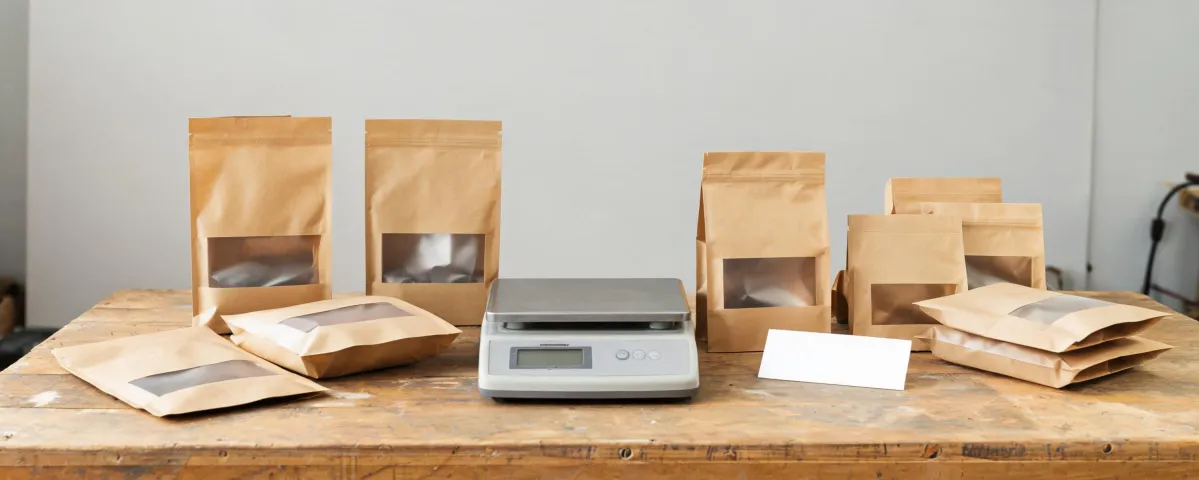
It took me about three years and 200+ orders to understand something that still makes a couple of my colleagues roll their eyes: in window kraft paper bag sourcing, the lowest unit price is almost never the cheapest option.
When I first took over packaging procurement, my brain had one metric — unit price. Whoever quoted lower got the order. I switched bag suppliers three times in my first year, and every switch felt like a win. Then at year-end I exported our entire purchase history and recalculated everything on a total-cost basis. The numbers didn't match the story I'd been telling myself.
That audit permanently changed how I buy kraft paper bags with window. Here's the breakdown.
The First Hidden Cost: The Lines That Aren't on the Quote
We ran a comparison last year that was almost too clean. Vendor A quoted $0.42/bag — plate fee included, one round of samples included, standard lead time. Vendor B quoted $0.38/bag — about 10% cheaper on paper.
But B's quote was bare-bones. Plate fee $150 extra. Samples $50 per round. Rush charge $200 each time. We ordered roughly 10,000 bags that year, so the unit price gap was about $400. The plate fee alone ate $150. Add sample rounds and one rush job, and B's real cost was $100–$300 higher than A's (I want to say the exact figure was $278, but don't quote me on that).
"Low price" and "cheap" aren't the same thing. Low price is the number on the quote sheet. Cheap is what's left in your budget at year-end.
This hidden cost pattern shows up more often on window bags, not less. Window shape, window film material, handle type — any non-standard change can trigger an extra fee that wasn't in the original quote. By the time you find out, you've already lost negotiating room.
The Second Hidden Cost: Standardize Specs Before You Negotiate Price
We used to change colors and handle styles every quarter. It felt flexible. In practice, every change meant a new sample round, a new confirmation cycle, a new internal approval. Our colored kraft paper bags with handles and white kraft paper bags with handles were even made at two different suppliers for a while — two plate fees, two sample rounds, two sets of back-and-forth emails.
So we set a rule: all brand colors locked to a PMS number, and every supplier must quote against a Delta E < 2 tolerance. The Pantone standard is straightforward — Delta E under 2 is invisible to the human eye, 2 to 4 is noticeable to trained observers, above 4 is visible to most people. We locked in at 2, and once a color was approved on a sample, repeat orders stopped becoming fights.
What surprised me wasn't the time savings. It was the sample approval rate. After we locked color specs, first-pass sample approval went from roughly 60% to over 90% — I'd have to dig through old QA logs for the exact number, but the direction is clear.
The same logic applies to paper weight. 80 gsm and 100 gsm kraft paper feel similar enough in a hand sample, but cost and load-bearing capacity are different. Plenty of buyers find out after the quote that they meant 100 gsm and the supplier quoted 80 gsm. Write the grammage and dimensions into a fixed spec sheet and you cut out a whole category of wasted emails.
One more: logo files. If that's all you have, provide a bitmap at 300 DPI minimum — that's the commercial print standard. Below that, edges print soft. Vector files are better, but plenty of clients genuinely only have a bitmap, and clarifying that upfront is cheaper than reworking after a bad sample.
The Third Hidden Cost: Process Speed Shows Up in the Budget
In Q1 and Q2 last year, we used the same bag supplier. The only difference: Q1 ran on email plus Excel reconciliation, Q2 ran on a standardized online inquiry form with required fields for dimensions, grammage, color, logo file format, and quantity.
Q1 averaged five days from inquiry to confirmation. Q2 averaged two. Same supplier — what changed was how information moved. Before, a single dimension confirmation or logo format question could eat three or four emails. Once the fields were fixed, the back-and-forth was cut roughly in half.
The ripple effects matter more than the email savings. Fewer sample rounds means fewer sample fees. Faster color confirmation means the production line isn't waiting on files. When we ran the year-end numbers, Q2's average order cost was about 12% below Q1 — mostly from fewer samples and fewer rush charges.
That 12% matters more than it sounds. If you're placing bulk orders — say 10,000+ kraft paper bags with handles annually — a 12% swing is real money, and it came from process discipline, not from squeezing the supplier.
"But We're Custom — Standardization Doesn't Work for Us"
I know the pushback. You make custom kraft paper bags with logo, colored and white, various handle types — every client wants something different. Standardization sounds like an impossible ask.
My answer: standardizing the input isn't the same as standardizing the product. You keep every color, size, and handle option. What changes is how you describe them. That has nothing to do with the product and everything to do with how cleanly you communicate with your vendor.
A good window bag sourcing partner usually hands you a spec sheet upfront — grammage, dimensions, window shape, film material, handle type, color reference, print file requirements. You fill it out, they quote against it, and negotiation becomes a comparison instead of a translation exercise. My habit now: before any deal, I look for that sheet. If it exists, the communication cost drops from day one.
So What Does "Cheap" Actually Mean?
The real cost advantage in window kraft paper bag sourcing doesn't come from who quotes lower. It comes from who produces fewer errors, fewer reworks, and fewer rounds of back-and-forth.
Sure, a few cents of unit-price difference is real money at scale. But next to the time and hidden costs you save once a process runs clean, it's not even the same order of magnitude. And once the process runs clean, your negotiating position actually gets stronger — because you know exactly what you need and what you shouldn't be paying for.
Not every company is the same. If you're buying a few hundred bags a year, building a procurement process probably isn't worth the effort. But once order volume crosses a certain line, process efficiency beats price negotiation every time.
That's the thing I wish I'd understood three years earlier: stop staring at the number on the quote sheet. Fix the process first. The money is there — it just doesn't come from your supplier. It comes from your own procurement flow.
Prices and figures above are based on personal experience and quoted for general reference; verify current rates and specifications before placing orders.